Visivra Official Website › Blog › Astaxanthin
Astaxanthin: One Good Trial, And A Great Deal Of Marketing
Astaxanthin is the most enthusiastically marketed ingredient in eye supplements relative to what has actually been published about it. There is one recent, well-designed trial worth knowing about, a combination study that cannot separate its ingredients, and a large body of laboratory work that is routinely quoted as though it were clinical evidence. This article separates the three.
What astaxanthin is
Astaxanthin is a red carotenoid produced by the microalga Haematococcus pluvialis, which makes it under stress. It is what turns salmon and flamingoes pink: they eat organisms that eat the algae.
Chemically it belongs to the same family as lutein and zeaxanthin, and it shares their fat solubility and their antioxidant behaviour. Where it differs is in distribution. Lutein and zeaxanthin are selectively concentrated in the macula by a dedicated mechanism. Astaxanthin is not; it distributes more widely through tissue and does not form part of macular pigment.
That difference is the reason it is a supporting ingredient in this category rather than a leading one, and any label that presents it as the star of an eye formula is arranging its list by marketing rather than by evidence.
The one trial worth reading
A 2025 randomised, double-blind, placebo-controlled trial gave 4 mg of astaxanthin a day for eighty-four days and measured acute and chronic digital eye strain. It reported improvement on both.
That is a genuinely good design for this field: randomised, blinded, placebo-controlled, a stated dose, a stated duration, and outcomes defined in advance. Most of what is published on astaxanthin and eyes is none of those things, which is why this one is worth naming.
Two caveats belong with it and neither cancels it. The participants were children, which is a different population from the adults an eye supplement is usually sold to. And the trial was conducted on a branded ingredient, which is normal in this field and is a reason to read the conflict-of-interest statement rather than a reason to dismiss the result.
The second real study is a 2021 randomised, double-blind, placebo-controlled trial that gave anthocyanin, astaxanthin and lutein together and measured eye functions. It is honest work and its limitation is structural: when three actives are given together, no analysis can tell you which of them did anything.
| Claim you will see | What supports it | How strong that is |
|---|---|---|
| Reduces digital eye strain | A 2025 randomised, double-blind, placebo-controlled trial, 4 mg a day, 84 days | One good trial, in children. Worth taking seriously and not worth generalising far. |
| Improves eye focusing and accommodation | A set of Japanese studies widely quoted in the trade | This desk could not retrieve them in PubMed and does not cite them. |
| Works alongside other carotenoids | A 2021 combination trial with anthocyanin and lutein | Real, and unable to separate the ingredients by design. |
| The most powerful antioxidant known | In-vitro antioxidant assays | A laboratory measurement. It says nothing about what happens in a person. |
Four claims, four very different kinds of support. The gap between row one and row four is the whole subject of this article.
The studies everybody quotes and nobody can find
Here is a piece of housekeeping most websites in this category skip.
The astaxanthin trade leans heavily on a set of Japanese studies from the mid 2000s, usually attributed to Nagaki, reporting improved accommodation and reduced eye fatigue. They are cited constantly, in marketing copy and in review articles that cite other review articles.
When this desk searched PubMed for them during the citation work for this website, they did not come back. That does not prove they do not exist; small journals outside the major indexes are real, and so are translation problems. What it does mean is that this desk cannot read them, cannot check what they measured, and cannot verify the amounts.
So they are not cited anywhere on this website. An unverifiable citation is worse than no citation, because it looks like evidence and cannot be checked. The astaxanthin case here rests on the two trials above and on nothing else.
A citation that circulates without anyone reading the original is the commonest failure mode in supplement marketing. It is worth applying the same test to any claim: can you get to the record itself, and does it say what the page citing it says it says?
Visivra names astaxanthin fourth, after the ingredients with more behind them
Six actives, ordered the way the evidence orders them, and a website that says which trials it could verify and which it could not.
Two bottles $158 · three bottles $207 · 60-day money-back guarantee
Order Visivra On The Official Website30 capsules a bottle · lot VIS-26/GO-1787 · ships from the U.S.
Antioxidant capacity is a laboratory number
The claim you will meet most often is some version of: astaxanthin is many times more powerful an antioxidant than vitamin C, or vitamin E, or beta carotene.
Those comparisons come from in-vitro assays. A compound is put in a test tube with something that generates free radicals, and how effectively it quenches them is measured. It is a real measurement of a real property.
What it is not is a statement about a person. Whether an antioxidant does anything useful in a body depends on whether it is absorbed, where it goes, what concentration it reaches there, how long it stays, and whether the tissue in question was under oxidative stress in a way that mattered. A test tube answers none of those. A review of astaxanthin sets out the breadth of what has been proposed for it, and the breadth is itself informative: a compound proposed for everything usually has strong evidence for very little.
The same caution applies to the whole antioxidant framing. NCCIH's plain-language summary is the place to start on why high-dose antioxidant supplementation has been disappointing in large trials more often than not.
How it compares with the two pigments beside it
| Lutein and zeaxanthin | Astaxanthin | |
|---|---|---|
| Found in the macula | Yes, concentrated there deliberately | No. It does not accumulate in macular pigment. |
| Meta-analyses available | Several | None of comparable size |
| Trials in healthy adults | Multiple, over months to years | Few, and the strongest recent one was in children |
| Dose used in the strongest trial | 10 mg and 2 mg a day | 4 mg a day |
| What is being claimed | Pigment density and contrast sensitivity | Eye strain and fatigue measures |
These are different ingredients doing different jobs, and the second one has a much smaller record. That is a description rather than a criticism.
The table is the argument. Lutein and zeaxanthin have a mechanism specific to the macula, meta-analyses behind them, and dose-response data. Astaxanthin has one strong recent trial in a different population and a combination study.
That is not a reason to leave it out of a formula. It is a reason to be suspicious of a formula that puts it first, prices itself on it, or describes it as the active ingredient.
- One well-designed 2025 trial supports a digital eye strain benefit at 4 mg a day over eighty-four days.
- One combination trial supports the combination and cannot isolate it.
- It is not part of macular pigment and does not claim to be.
- Laboratory antioxidant comparisons are not clinical evidence and should not be quoted as though they were.
- The accommodation studies widely cited in the trade could not be retrieved by this desk and are not used anywhere on this website.
What Visivra claims, and what it does not
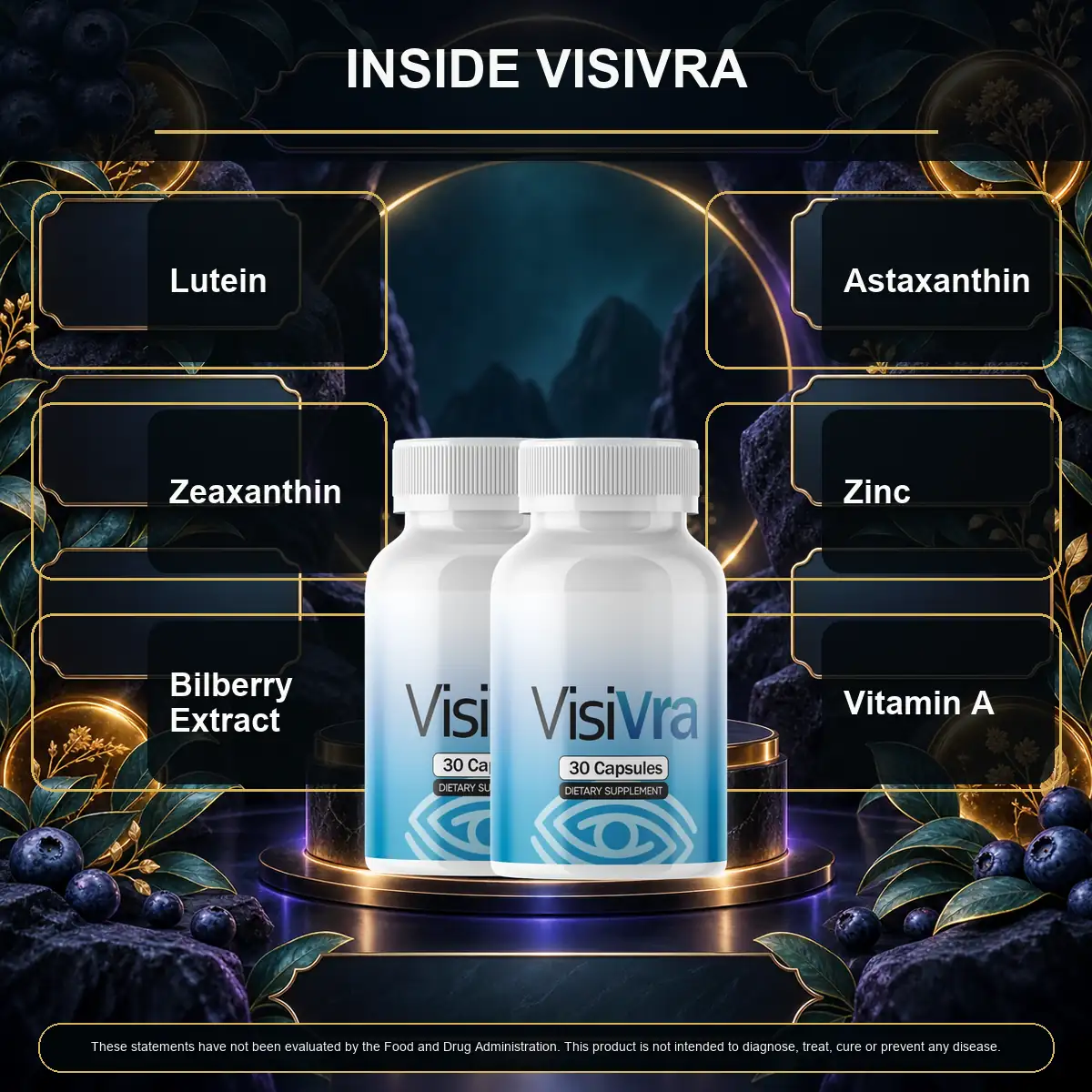
Visivra lists astaxanthin fourth among six, which is roughly where the evidence puts it. Neither the artwork nor the seller's page claims anything specific about it: the four printed supports are about clarity, retinal function, long-term eye wellness and blue light, and they attach to the formula rather than to any one ingredient. Those four are reproduced and examined on the benefits page.
The amount is not printed, as it is not for the other five, so the 4 mg figure from the trial cannot be set against this capsule. That comparison is laid out on the ingredients page with the same empty column that runs down every other row.
On blue light specifically, it is worth noting what the best available evidence says about the underlying premise. The 2023 Cochrane review of blue-light filtering lenses found no clear benefit for visual performance, eye strain or macular health, and a review of nutrition and digital eye strain is similarly cautious about the field as a whole.
This is a dietary supplement website and this article is product information. Nothing here treats, prevents or manages macular degeneration, cataract, glaucoma or any diagnosed eye condition, and nothing here is a substitute for an eye examination. Sight that has changed is a reason to book one.
The bottom line
Astaxanthin is a legitimate ingredient with a small and recent clinical record, and it is marketed as though it had a large and old one.
One trial at 4 mg a day over eighty-four days is worth knowing about. A combination study is worth knowing about with the caveat attached. Laboratory antioxidant rankings are not evidence about people, and a widely quoted set of accommodation studies could not be retrieved by this desk and is therefore not used on this website at all.
In a six-ingredient formula led by lutein and zeaxanthin, astaxanthin is a reasonable fourth. As the headline of an eye supplement it would be a claim considerably larger than its evidence, and the checklist has a question about exactly that.
References
- Hecht KA, Marwah M, Wood V, et al: “Astaxanthin (AstaReal) improved acute and chronic digital eye strain in children: a randomized double-blind placebo-controlled trial”, Adv Ther 2025;42(4):1811-1833, PMID 40014233. https://pubmed.ncbi.nlm.nih.gov/40014233/
- Kizawa Y, Sekikawa T, Kageyama M, et al: “Effects of anthocyanin, astaxanthin, and lutein on eye functions: a randomized, double-blind, placebo-controlled study”, J Clin Biochem Nutr 2021;69(1):77-90, PMID 34376917. https://pubmed.ncbi.nlm.nih.gov/34376917/
- Kidd P: “Astaxanthin, cell membrane nutrient with diverse clinical benefits and anti-aging potential”, Altern Med Rev 2011;16(4):355-64, PMID 22214255. https://pubmed.ncbi.nlm.nih.gov/22214255/
- Lem DW, Gierhart DL, Davey PG: “Can nutrition play a role in ameliorating digital eye strain?”, Nutrients 2022;14(19):4005, PMID 36235656. https://pubmed.ncbi.nlm.nih.gov/36235656/
- Singh S, Keller PR, Busija L, et al: “Blue-light filtering spectacle lenses for visual performance, sleep, and macular health in adults”, Cochrane Database Syst Rev 2023;8(8):CD013244, PMID 37593770. https://pubmed.ncbi.nlm.nih.gov/37593770/
- National Center for Complementary and Integrative Health: “Antioxidants: In Depth”. https://www.nccih.nih.gov/health/antioxidants-in-depth