Visivra Official Website › Ingredients
IngredientsWhat Is in Visivra? Ingredients List and Roles
Visivra Team at Govisivra · physician review: Dr. Preston Sullivan, MD · last revised
Visivra is built on two macular carotenoids, two antioxidant pigments and two nutrients the retina uses.
By name they are lutein and zeaxanthin, bilberry extract and astaxanthin, then zinc and vitamin A. This page shows the amounts the published trials used for each.
To see when to take them, go to the daily routine.
Six names, taken from two documents that agree with each other, with the evidence for each one linked in the sentence that describes it.
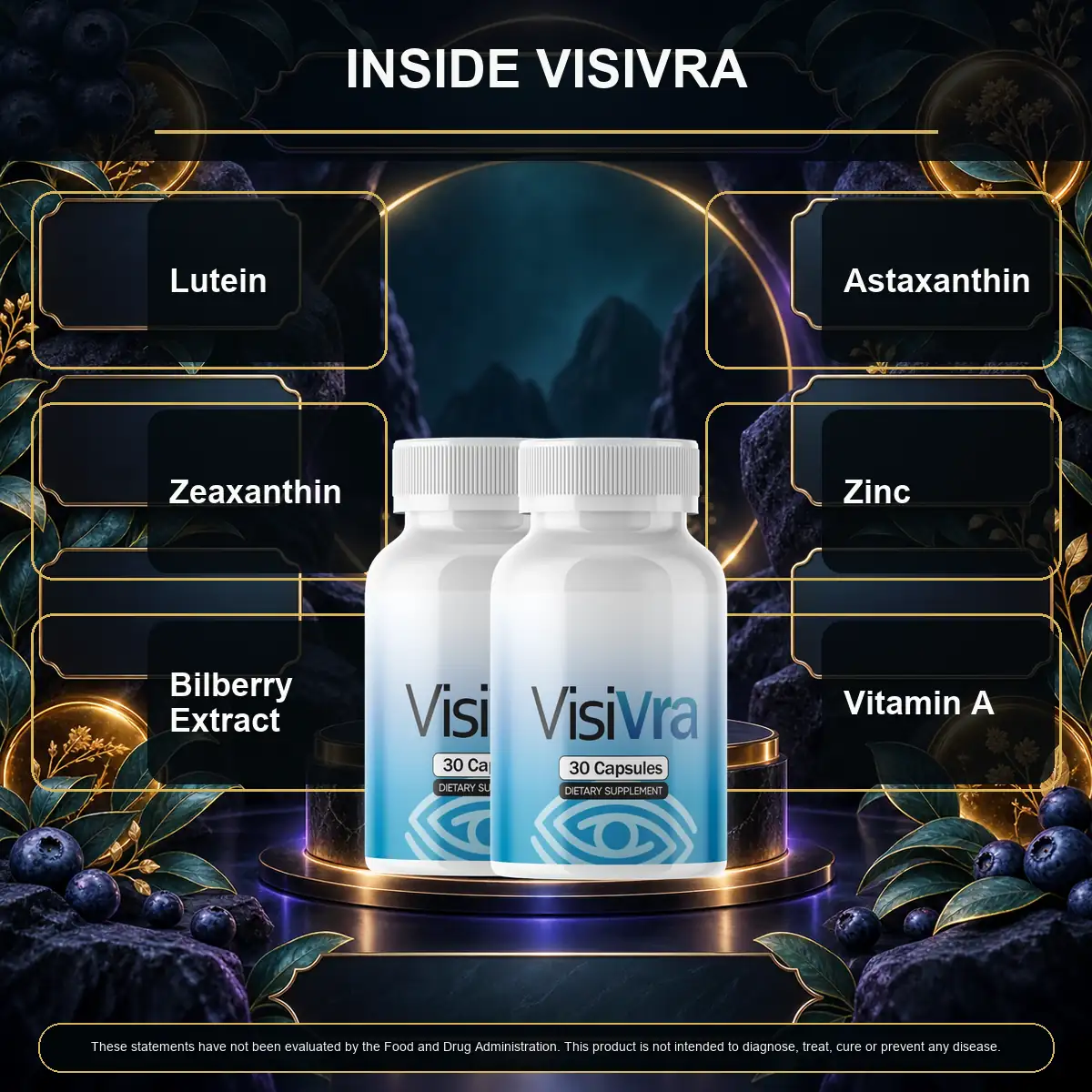
The six actives named on the Visivra artwork
The vendor tile and the seller’s page list the same six in the same order. Nothing below is inferred from a photograph.
Lutein
from Tagetes erectaAmount: seller’s figureA xanthophyll carotenoid the body cannot synthesise. It accumulates in the macula, mostly in the outer parts of it, where it absorbs short-wavelength light and behaves as an antioxidant. A 2019 meta-analysis of lutein supplementation found macular pigment optical density rose with intake, and a 2020 randomised trial measured contrast sensitivity alongside it. The trials that produced those results used 10 mg a day.
Zeaxanthin
from Tagetes erectaAmount: seller’s figureLutein’s structural isomer, and the pigment that dominates the very centre of the macula where lutein thins out. It is almost never studied alone: AREDS2 gave 2 mg of it alongside 10 mg of lutein, and a dose comparison in high myopia found the pigment response tracked the amount given. A 2014 meta-analysis treats the pair together for that reason.
Bilberry Extract
Vaccinium myrtillusAmount: seller’s figureAn anthocyanin-rich fruit extract with a reputation older than its evidence. The wartime night-vision story does not survive testing: a systematic review of placebo-controlled trials found the positive results were the uncontrolled ones. What has held up is more modest and more recent. A twelve-week trial at 240 mg a day measured improved ciliary muscle contraction, and a study in screen workers at 480 mg a day measured lower eye fatigue.
Astaxanthin
from Haematococcus pluvialisAmount: seller’s figureA red carotenoid from microalgae, and the most heavily marketed ingredient in this category relative to its published record. A 2025 randomised trial gave 4 mg a day for eighty-four days and reported improvement in acute and chronic digital eye strain; its participants were children. A three-carotenoid trial tested it alongside anthocyanin and lutein. The accommodation studies the trade quotes most often could not be verified in this desk’s searches, so they are not cited here.
Zinc
Amount: seller’s figureAn essential trace mineral and a cofactor for enzymes in the retinal pigment epithelium. It earned its place in eye formulas through the original AREDS trial, which used 80 mg a day paired with 2 mg of copper. The pairing was deliberate: sustained high-dose zinc lowers copper status, and the clinical picture when that happens is well described. AREDS2 later tested a 25 mg arm. Where this capsule sits on that range is the seller’s to say.
Vitamin A
Amount and form: seller’s figuresThe precursor of rhodopsin, the pigment that makes low-light vision work, and the one row on this label where the FORM decides the safety picture. Preformed retinol carries an adult upper intake level and has been associated with higher fracture risk at high serum levels. Beta carotene carries a different caution entirely: AREDS2 removed it after CARET and ATBC reported more lung cancer among smokers taking it. The artwork names the nutrient and not the form.
What the Visivra label gives, and what the trials used
One table, in one place. Everywhere else on this site describes what the capsule contains; here is the comparison a buyer actually wants, with both columns filled in as far as they can be.
Read the right column as context, never as a property of this bottle. The amounts there belong to the trials they came from and to the populations those trials enrolled. They are printed because in this category the amount is the evidence, and a reader holding a bottle with no figures on it should at least be able to see what the figure would have to be for a comparison to mean anything.
How the six Visivra ingredients divide up
| Ingredient | What it is | Strength of the evidence in eyes |
|---|---|---|
| Lutein | Dietary carotenoid | Strongest here. Meta-analyses and randomised trials. |
| Zeaxanthin | Dietary carotenoid | Strong, but almost always studied alongside lutein. |
| Bilberry extract | Anthocyanin fruit extract | Moderate and recent. Ciliary muscle and eye fatigue, not night vision. |
| Astaxanthin | Algal carotenoid | Thin but real. One 2025 controlled trial, one combination trial. |
| Zinc | Essential mineral | Strong as part of a formula, at an amount this label does not give. |
| Vitamin A | Essential vitamin | Established for deficiency. In supplemented eye formulas the story is about form and about risk. |
This is the desk’s reading of the citation set at the foot of the page, not a score published by anyone else.
The useful way to hold this: two ingredients carry the category, two add something measurable in screen-heavy eyes, and two are there as nutrients whose value depends entirely on an amount nobody outside the factory knows.
Medication notes for the Visivra panel
Zinc and long-term use
Months of high-dose zinc lowers copper. A controlled trial in healthy boys found no change in sensitive copper markers at modest intakes, which is reassuring at the small end of the range and says nothing about the large end.
Vitamin A and smoking
If the vitamin A here is beta carotene, the smoking caution applies. That is the one question to settle with the seller before the first capsule, and it takes one phone call.
Carotenoids and fat absorption
Four of the six are fat-soluble. Anything that reduces dietary fat absorption reduces what you get from them, which is a timing question rather than a safety one.
Stacking with a multivitamin
Zinc and vitamin A appear on most multivitamin panels. Two bottles add up, and only one of them shows you its numbers.
Visivra ingredient questions
Which ingredient is the most important one here?
Lutein, with zeaxanthin beside it. They are the two pigments the macula is actually built from, and they are the reason this category exists at all. The other four support them.
Is bilberry the same thing as blueberry?
Related, not the same. Vaccinium myrtillus is the European bilberry and it carries a higher anthocyanin load than a cultivated blueberry. Extracts used in trials are standardised to those anthocyanins; a berry is not.
Why does the label name vitamin A without saying which kind?
That is a question for the seller, and it is the single most useful line the artwork could have added. Preformed retinol and beta carotene behave differently in the body and carry different cautions.
Is astaxanthin worth having in an eye capsule?
It has one recent controlled trial in digital eye strain and one combination trial behind it. That is a thinner record than lutein has, and it is a real record rather than folklore.
Are there fillers or a capsule shell listed?
No other-ingredients line appears on the artwork, so the shell material and any excipients stay with the manufacturer. Anyone with a gelatine restriction should settle that with the seller first.
Who publishes this Visivra website?
Each record below is linked in the sentence above that relies on it, which is why the list is this long on this page and shorter elsewhere.
- Machida N, Kosehira M, Kitaichi N: “Clinical effects of dietary supplementation of lutein with high bio-accessibility on macular pigment optical density and contrast sensitivity: a randomized double-blind placebo-controlled parallel-group comparison trial”, Nutrients 2020;12(10):2966, PMID 32998324. https://pubmed.ncbi.nlm.nih.gov/32998324/
- Feng L, Nie K, Jiang H, et al: “Effects of lutein supplementation in age-related macular degeneration”, PLoS One 2019;14(12):e0227048, PMID 31887124. https://pubmed.ncbi.nlm.nih.gov/31887124/
- Liu R, Wang T, Zhang B, et al: “Lutein and zeaxanthin supplementation and association with visual function in age-related macular degeneration”, Invest Ophthalmol Vis Sci 2014;56(1):252-8, PMID 25515572. https://pubmed.ncbi.nlm.nih.gov/25515572/
- Zhang Y, Hao J, Cao K, et al: “Macular pigment optical density responses to different levels of zeaxanthin in patients with high myopia”, Graefes Arch Clin Exp Ophthalmol 2022;260(7):2329-2337, PMID 35044504. https://pubmed.ncbi.nlm.nih.gov/35044504/
- Kosehira M, Machida N, Kitaichi N: “A 12-week-long intake of bilberry extract (Vaccinium myrtillus L.) improved objective findings of ciliary muscle contraction of the eye: a randomized, double-blind, placebo-controlled, parallel-group comparison trial”, Nutrients 2020;12(3):600, PMID 32106548. https://pubmed.ncbi.nlm.nih.gov/32106548/
- Ozawa Y, Kawashima M, Inoue S, et al: “Bilberry extract supplementation for preventing eye fatigue in video display terminal workers”, J Nutr Health Aging 2015;19(5):548-54, PMID 25923485. https://pubmed.ncbi.nlm.nih.gov/25923485/
- Canter PH, Ernst E: “Anthocyanosides of Vaccinium myrtillus (bilberry) for night vision - a systematic review of placebo-controlled trials”, Surv Ophthalmol 2004;49(1):38-50, PMID 14711439. https://pubmed.ncbi.nlm.nih.gov/14711439/
- Hecht KA, Marwah M, Wood V, et al: “Astaxanthin (AstaReal) improved acute and chronic digital eye strain in children: a randomized double-blind placebo-controlled trial”, Adv Ther 2025;42(4):1811-1833, PMID 40014233. https://pubmed.ncbi.nlm.nih.gov/40014233/
- Kizawa Y, Sekikawa T, Kageyama M, et al: “Effects of anthocyanin, astaxanthin, and lutein on eye functions: a randomized, double-blind, placebo-controlled study”, J Clin Biochem Nutr 2021;69(1):77-90, PMID 34376917. https://pubmed.ncbi.nlm.nih.gov/34376917/
- Age-Related Eye Disease Study Research Group: “A randomized, placebo-controlled, clinical trial of high-dose supplementation with vitamins C and E, beta carotene, and zinc for age-related macular degeneration and vision loss: AREDS report no 8”, Arch Ophthalmol 2001;119(10):1417-36, PMID 11594942. https://pubmed.ncbi.nlm.nih.gov/11594942/
- Amisha F, Saluja P, Gautam N, et al: “Acquired hyperzincaemia due to zinc-laden denture adhesives leading to hypocupraemia as a cause of neutropenia”, Eur J Case Rep Intern Med 2021;8(11):002983, PMID 34912740. https://pubmed.ncbi.nlm.nih.gov/34912740/
- Bertinato J, Simpson JR, Sherrard L, et al: “Zinc supplementation does not alter sensitive biomarkers of copper status in healthy boys”, J Nutr 2013;143(3):284-9, PMID 23303874. https://pubmed.ncbi.nlm.nih.gov/23303874/
- Omenn GS, Goodman GE, Thornquist MD, et al: “Effects of a combination of beta carotene and vitamin A on lung cancer and cardiovascular disease”, N Engl J Med 1996;334(18):1150-5, PMID 8602180. https://pubmed.ncbi.nlm.nih.gov/8602180/
- Alpha-Tocopherol, Beta Carotene Cancer Prevention Study Group: “The effect of vitamin E and beta carotene on the incidence of lung cancer and other cancers in male smokers”, N Engl J Med 1994;330(15):1029-35, PMID 8127329. https://pubmed.ncbi.nlm.nih.gov/8127329/
- Michaelsson K, Lithell H, Vessby B, et al: “Serum retinol levels and the risk of fracture”, N Engl J Med 2003;348(4):287-94, PMID 12540641. https://pubmed.ncbi.nlm.nih.gov/12540641/
- Institute of Medicine (US) Panel on Micronutrients: “Vitamin A”, In: Dietary Reference Intakes for Vitamin A, Vitamin K, Arsenic, Boron, Chromium, Copper, Iodine, Iron, Manganese, Molybdenum, Nickel, Silicon, Vanadium, and Zinc, Washington (DC): National Academies Press; 2001. https://www.ncbi.nlm.nih.gov/books/NBK222318/
Order Visivra with the ingredient list in front of you
Six names, four carotenoids and two nutrients, and a sixty-day window from shipping in which to decide whether the routine suits you.
Two bottles $158 · three bottles $207 · 60-day money-back guarantee
Order Visivra On The Official Website30 capsules a bottle · lot VIS-26/GO-1787 · ships from the U.S.