Visivra Official Website › Blog › Macular Pigment
Macular Pigment: The Layer This Whole Category Is Aimed At
Every eye supplement on the shelf is aimed at one thing: a yellow layer about five millimetres across at the back of your eye, built entirely out of pigments your body cannot make. Understanding what that layer is explains why these products are slow, why they change contrast rather than sharpness, and why the amount on the label matters more here than in almost any other category.
What macular pigment actually is
The macula is the central patch of the retina, roughly five millimetres across, that does essentially all of your detailed vision. Everything outside it is peripheral: useful for movement and orientation, useless for reading a road sign.
Sitting in front of the photoreceptors in that patch is a layer of yellow pigment. It is made of three carotenoids: lutein, zeaxanthin and meso-zeaxanthin. The yellow is not incidental; it is what the layer does. Yellow pigment absorbs blue light, which is the short-wavelength, high-energy end of the visible spectrum, and it absorbs it before that light reaches the cells behind it.
The layer has a second job. The macula has the highest metabolic rate of any tissue in the body by weight, and high metabolic rate means oxidative stress. Carotenoids are antioxidants. So the pigment is simultaneously a filter and a buffer, sitting in the one place in the eye that most needs both.
Three pigments, not two
Lutein dominates the outer macula and zeaxanthin the very centre. The third, meso-zeaxanthin, is barely present in food at all: the retina converts it from lutein on site. That is worth knowing because some formulas include it directly and some rely on the conversion, and a label naming two pigments rather than three is not necessarily worse for it.
Where it comes from, and why none of it is made
The human body synthesises none of these three carotenoids. Every molecule in that layer arrived through the diet, was absorbed in the gut, travelled in the blood on lipoproteins, and was selectively taken up by the retina.
That last step is genuinely remarkable. There are more than six hundred carotenoids in nature and perhaps twenty circulate in human blood, but the macula concentrates three of them, and it concentrates them to levels far above what is in the bloodstream. There is a dedicated binding protein for it. This is not incidental accumulation; the tissue is going out of its way.
The dietary sources are narrow. Dark leafy greens carry the most by weight, sweetcorn and orange peppers are the notable zeaxanthin sources, and egg yolk is the most absorbable common source despite carrying far less per gram than kale.
| Food | Roughly what it carries | How well it is absorbed |
|---|---|---|
| Cooked kale or spinach | The densest common source by weight | Moderate. Better with oil, poor without. |
| Egg yolk | Far less per gram than greens | The best of the common sources, because the pigment arrives dispersed in fat |
| Sweetcorn | A modest amount, and the main dietary zeaxanthin source | Moderate |
| Orange peppers | One of the few concentrated zeaxanthin sources | Moderate |
| A capsule | Whatever the label says, and here the label says nothing | Depends entirely on the formulation and the meal it is taken with |
Egg yolk is the instructive row: it carries less pigment than kale and delivers more of it, which is a point about fat rather than about quantity.
A person who eats none of those in a typical week is getting very little of either pigment, and has no other route to them. That is the whole biological case for a supplement in this category, and it is a good one as far as it goes.
How it is measured, and what that number means
Macular pigment optical density, usually shortened to MPOD, is the standard measure. It can be taken in a clinic without anything entering the eye, most often by heterochromatic flicker photometry, which asks you to adjust a flickering light until the flicker disappears.
The figure it produces is a density, not a thickness, and it varies a great deal between individuals. What matters for a supplement question is not the absolute number but whether it moves, which is why every trial in this field reports a change from baseline rather than a target value.
A 2019 meta-analysis pooled the lutein supplementation trials and found pigment density rose with intake in a dose-dependent way. An earlier meta-analysis reached the same conclusion for lutein and zeaxanthin together, and a dose comparison in high myopia found the response tracked the amount given. Dose-dependent is the phrase to notice: it means the number on the label is not decorative.
- It is not visual acuity. A thicker pigment layer does not change the prescription.
- It is not a diagnosis. A low reading is not a disease and a high one is not protection.
- It is not fixed. It responds to diet and to supplementation over months.
- It is not something you can estimate at home. If you want it measured, an optometrist with the right instrument is the only route.
Visivra supplies two of the three macular pigments
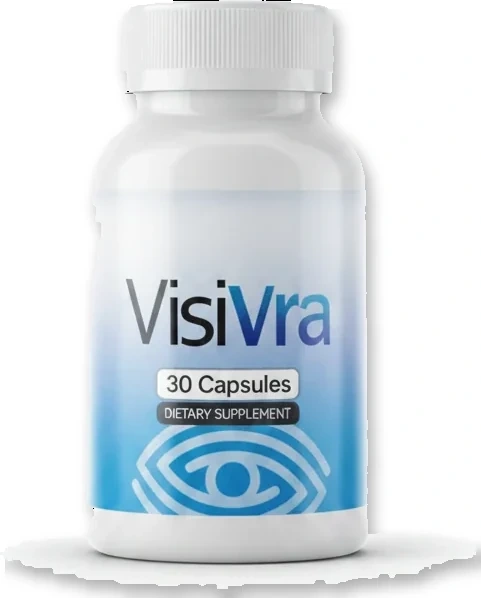
Lutein and zeaxanthin lead the named list on this label, and one capsule a day is the routine. Three bottles covers the ninety days the published trials work over.
Two bottles $158 · three bottles $207 · 60-day money-back guarantee
Order Visivra On The Official Website30 capsules a bottle · lot VIS-26/GO-1787 · ships from the U.S.
What a thicker layer does, and what it does not
This is where the category consistently overreaches, so it is worth being precise.
The CREST trial enrolled people free of retinal disease, supplemented them for twelve months, and measured contrast sensitivity. It improved. A second trial measured contrast sensitivity and lateral inhibition and found the same direction. A 2020 randomised trial paired the pigment change and the contrast change in the same study.
Contrast sensitivity is the ability to distinguish something from a background of similar brightness. It is not what the letter chart measures. The chart measures acuity, which is mostly about the optics of the eye, and a carotenoid does not change optics.
So the honest description of what a thicker pigment layer buys is: better performance in low contrast and in glare. That is fog, headlights, dusk, and a low-contrast screen. It is a real category of experience and it is not sharper letters.
| Trial | What it gave | How long | What moved |
|---|---|---|---|
| CREST | Lutein, zeaxanthin and meso-zeaxanthin | 12 months | Macular pigment density and contrast sensitivity, in healthy retinas |
| A 2020 lutein trial | Lutein with high bio-accessibility | Months | Pigment density and contrast sensitivity |
| A contrast-sensitivity trial | Macular carotenoids | Months | Contrast sensitivity and lateral inhibition |
| A zeaxanthin dose comparison | Different zeaxanthin levels | Months | Pigment density, tracking the amount given |
Every one of these ran for months. Nothing in this table was measured in a week, because the layer being measured is not built in a week.
Everything above concerns pigment density and visual function in healthy eyes. It is not about slowing or preventing any disease, and the trials that address that question enrolled a different population and used a different formula. Macular degeneration, cataract and glaucoma are diagnosed and managed by an eye clinician, and none of them is a supplement question.
Raising it: food, capsules and time
Three things determine what happens to the layer, and only one of them is which bottle you buy.
- Intake. Food, a capsule, or both. The pigments are the same molecules either way.
- Absorption. Carotenoids are fat-soluble and their absorption depends heavily on the fat eaten with them, which is why egg yolk outperforms kale per microgram.
- Time. Serum levels rise within days. The layer itself moves over weeks and months, and every trial above ran for months for that reason.
The time element is the one buyers underestimate and the one that decides whether a purchase was worth making. Somebody who takes a carotenoid capsule for a fortnight and concludes it did nothing has run a test that could not have produced any other answer. The results timeline page sets out what a fair test looks like.
Where Visivra sits in that picture
Visivra names lutein and zeaxanthin first on its list of six, which is the correct order for a product aimed at this layer. It is a capsule, which is the right vehicle for a fat-soluble pigment.
What it does not do is print how much of either is in there, and this article is the clearest possible explanation of why that matters. The research above is dose-dependent. A label with no dose on it cannot be placed anywhere on those curves, by this desk or by anyone else. That is set out at length on the ingredients page, where the trial amounts are printed beside a column with nothing in it.
It is worth saying what that does not mean. It does not mean the capsule contains nothing, and it does not mean the ingredient list is wrong. It means the one question this article has shown to be the important one is the question the label declines to answer.
The bottom line
Macular pigment is a real, measurable structure, built entirely from three carotenoids the body cannot make, sitting in the one part of the retina that does your detailed seeing. Raising intake raises it, in a dose-dependent way, over months.
What it buys, where it has been measured in healthy eyes, is contrast sensitivity and glare performance rather than acuity. Anyone expecting to read a smaller line on the chart has misunderstood what the layer does.
And the whole thing runs on amounts. That is why the first question on the checklist is whether the label has a panel on it, and why this desk publishes what the trials used rather than pretending it knows what the capsule holds.
References
- Feng L, Nie K, Jiang H, et al: “Effects of lutein supplementation in age-related macular degeneration”, PLoS One 2019;14(12):e0227048, PMID 31887124. https://pubmed.ncbi.nlm.nih.gov/31887124/
- Nolan JM, Power R, Stringham J, et al: “Enrichment of macular pigment enhances contrast sensitivity in subjects free of retinal disease: Central Retinal Enrichment Supplementation Trials - report 1”, Invest Ophthalmol Vis Sci 2016;57(7):3429-39, PMID 27367585. https://pubmed.ncbi.nlm.nih.gov/27367585/
- Stringham JM, O'Brien KJ, Stringham NT: “Contrast sensitivity and lateral inhibition are enhanced with macular carotenoid supplementation”, Invest Ophthalmol Vis Sci 2017;58(4):2291-2295, PMID 28431432. https://pubmed.ncbi.nlm.nih.gov/28431432/
- Machida N, Kosehira M, Kitaichi N: “Clinical effects of dietary supplementation of lutein with high bio-accessibility on macular pigment optical density and contrast sensitivity: a randomized double-blind placebo-controlled parallel-group comparison trial”, Nutrients 2020;12(10):2966, PMID 32998324. https://pubmed.ncbi.nlm.nih.gov/32998324/
- Liu R, Wang T, Zhang B, et al: “Lutein and zeaxanthin supplementation and association with visual function in age-related macular degeneration”, Invest Ophthalmol Vis Sci 2014;56(1):252-8, PMID 25515572. https://pubmed.ncbi.nlm.nih.gov/25515572/
- Zhang Y, Hao J, Cao K, et al: “Macular pigment optical density responses to different levels of zeaxanthin in patients with high myopia”, Graefes Arch Clin Exp Ophthalmol 2022;260(7):2329-2337, PMID 35044504. https://pubmed.ncbi.nlm.nih.gov/35044504/